The choice between inshore and offshore fishing dictates your entire maritime journey. It defines the specific species you target. It also dictates your financial and logistical commitment to gear, safety, and vessel capabilities. Many eager anglers make a critical mistake. They attempt to use the wrong vessel for open-water environments. This mismatch leads to severe safety risks and poor on-water performance. A flat-bottom skiff simply cannot survive rolling ocean swells safely. You need the right tool for the job. Our objective is to clearly define the boundaries between inshore and offshore fishing. We will provide a practical framework for evaluating the right offshore fishing boat for your specific maritime needs. You will learn how water depth, hull design, and gear requirements shift dramatically as you leave the sight of land. Proper preparation ensures you return to the dock safely every single time.
Key Takeaways
Water Depth & Distance: Inshore fishing generally occurs in waters less than 30 meters deep within sight of land; offshore (deep sea) fishing targets pelagic zones requiring specialized navigation.
Vessel Requirements: An offshore fishing boat requires a specific hull design (deep-V), higher freeboard, and expanded fuel capacity compared to flat-bottom inshore skiffs.
Material Durability: Modern aluminum hulls offer a distinct weight-to-durability advantage for anglers evaluating offshore capabilities without the maintenance overhead of fiberglass.
Entry-Level Scalability: Vessels in the 6-meter to 6.25-meter range provide an optimal baseline for anglers transitioning from inshore to offshore, provided weather windows are strictly observed.
Defining the Zones: Where Does Inshore End and Offshore Begin?
To understand vessel requirements, we must first define the playing field. Geographic and depth thresholds draw a hard line between these two fishing styles. The standard transition point to offshore waters typically begins 9 to 30 miles out. In terms of depth, offshore fishing starts when the ocean floor drops beyond 30 meters (100 feet). Some regions experience this drop-off close to shore. Other regions require hours of navigation to reach deep water.
Water conditions change drastically as you push further out. Inshore zones include bays, estuaries, and tidal rivers. These areas offer relatively sheltered, predictable tides. The shoreline breaks the wind and minimizes wave height. Offshore environments expose you directly to open blue water. Here, you face variable swells, strong unpredictable currents, and rapid weather shifts. You cannot simply outrun a sudden storm in deep water. Offshore currents often create chaotic standing waves.
We also must clarify the "nearshore" grey area. This transitional zone spans from the beaches out to roughly 9 miles. Inshore boats often reach their absolute structural limits here. They can handle a calm nearshore day comfortably. However, they fail quickly if coastal winds pick up and chop builds. Understanding this boundary keeps you alive.
Fishing Zones Characteristics Summary
| Zone | Distance from Shore | Typical Depth | Water Conditions |
| Inshore | 0 to 3 miles | Less than 10 meters | Sheltered, predictable, calm tides |
| Nearshore | 3 to 9 miles | 10 to 30 meters | Moderate chop, transitional swells |
| Offshore | 9+ miles | 30+ meters | Open ocean swells, rapid changes |
Target Species and the Cost of Gear Upgrades
Your target species dictate your entire gear setup. Inshore target profiles focus heavily on structure-oriented species. Anglers hunt redfish, snook, and tarpon around mangroves, bridges, and docks. This environment requires light to medium tackle. You need casting platforms and absolute stealth. Anglers rely heavily on electric trolling motors and push poles. They stalk fish silently in less than one meter of water.
Offshore target profiles shift entirely to pelagic species. You will pursue aggressive predators like tuna, mahi-mahi, and marlin in open water. These fast, powerful fish demand a completely different strategic approach.
This shift forces a major evaluation dimension from basic gear to outcome-driven setups. Offshore fishing necessitates heavy-duty trolling gear and wide spreads. A fish striking at 40 miles per hour requires massive drag pressure. You need outriggers to manage multiple lines without tangling. You also need advanced sonar systems. High-frequency sonar helps locate deep baitballs and thermoclines. This fundamentally changes the spatial requirements of your vessel. A small skiff cannot safely mount heavy outriggers. It also lacks the console space for large dual-screen navigation displays.
Drag Calibration: Always match your rod and reel drag capacity to the immense power of target pelagic species.
Common Mistake: Using inshore spinning gear for offshore trolling often results in snapped lines and lost trophy fish.
Deck Storage: Ensure your deck layout can accommodate large insulated coolers to preserve pelagic catches properly.
Transducer Placement: Mount thru-hull transducers securely to read deep-water structures accurately while running at speed.
The Deciding Factor: Evaluating an Offshore Fishing Boat
When leaving protected waters, your hull design becomes your primary lifeline. Inshore skiffs feature flat or shallow-V bottoms to navigate skinny water effortlessly. They pound dangerously when driven into offshore swells. This pounding destroys equipment and exhausts the crew. A dedicated Offshore Fishing Boat utilizes a deep-V hull design. This sharp deadrise, often exceeding 18 degrees, slices through aggressive chop cleanly. It provides a significantly softer ride and reduces physical fatigue over long journeys.
Freeboard and deck drainage represent non-negotiable safety features. High gunwales keep large waves out of the cockpit. Self-bailing decks are an absolute safety necessity. If a rogue wave crashes over the bow, gravity must drain the water instantly through large scuppers. An enclosed, self-bailing hull prevents the vessel from swamping in rough conditions.
Fuel capacity and redundancy keep you alive offshore. Frame your offshore safety around the strict "rule of thirds" for fuel management. You use one-third of your tank to reach your destination. You use one-third to return home. You keep one-third in reserve for emergencies, like fighting strong headwinds. You also must install dual-battery setups with an isolation switch. Reliable VHF communications ensure you can broadcast a distress call if your engines fail miles from shore.
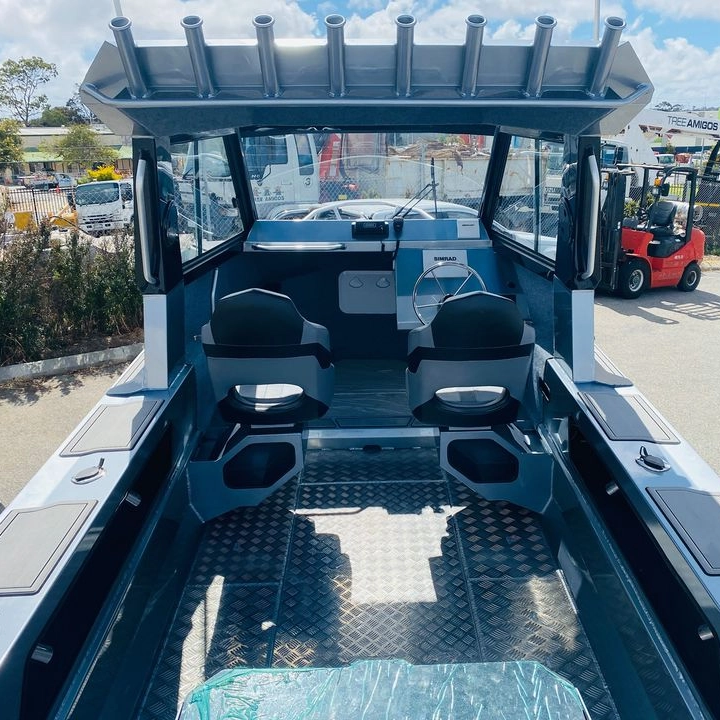
Aluminum vs. Fiberglass for Open Water Scalability
For decades, the heavy fiberglass tradition dominated open offshore waters. Fiberglass allows builders to mold complex hull shapes for heavy displacement. However, modern marine-grade aluminum has closed this performance gap entirely. Computer-aided technology now allows builders to craft highly precise deep-V aluminum hulls.
The implementation realities of aluminum present massive everyday advantages. Aluminum offers a much lighter towing weight. This saves expensive highway fuel and requires a smaller, more accessible tow vehicle. You also gain superior fuel efficiency on the water due to less hull drag. Furthermore, aluminum provides extreme impact resistance. It easily deflects submerged debris or accidental dock impacts without cracking. Fiberglass gelcoats require constant polishing and expensive repairs when chipped.
To understand quality, look closely at the Easy Craft manufacturing approach. It serves as an excellent baseline for evaluating structural integrity. You must focus on marine-grade plate thickness. You must inspect the quality of the continuous welded seams. A well-built aluminum hull offers exceptional ride stability in offshore conditions. It handles punishing waves while remaining structurally sound for decades.
Sizing Your Vessel: Can a 6-Meter Boat Handle Offshore Fishing?
Anglers often fall for the "size vs. capability" misconception. Many assume offshore boats must be 30 feet long or larger to be safe. This is simply not true. Hull geometry matters just as much as the length overall (LOA). A smartly designed, compact vessel can safely navigate blue water if piloted correctly.
Evaluating the 6m Easy Craft Aluminum Fishing Boatproves this vital point. This specific 6-meter vessel serves as a highly capable crossover boat. It drafts shallow enough for deep bays and nearshore reefs. It also handles moderate offshore days with impressive ease. It features the necessary high freeboard and robust forward cabin protection to deflect ocean spray.
If you plan to scale up, carefully consider the 6.25m Aluminum Fishing Boat. Stepping up to a 6.25-meter model provides distinct, measurable marginal gains. You get an increased fuel payload for extended offshore range. You gain a slightly wider beam for better side-to-side drift stability. You also unlock expanded deck space to accommodate multiple anglers casting simultaneously.
We must transparently discuss risk mitigation. A 6m to 6.25m boat is fully offshore-capable. However, smaller offshore vessels require strict operational discipline. Follow these crucial steps before every single trip:
Analyze Weather Windows: Never push into worsening forecasts, high-wind warnings, or rapidly falling barometric pressure.
Respect Vessel Limits: Understand exactly how your specific boat handles following seas and quartering swells.
Maintain Communications: Ensure your VHF radio, GPS, and emergency beacons operate perfectly before launching.
Balance the Load: Distribute heavy gear, fuel, and ice evenly to maintain the vessel's designed center of gravity.
Conclusion
Upgrading to offshore fishing introduces an entirely new decision matrix. You must consciously shift your focus away from the stealth and shallow draft needed inshore. Instead, you must aggressively prioritize safety features, extended fuel range, and hull capability. The open ocean demands a vessel built to survive unpredictable elements.
Our shortlisting logic favors practical, highly durable solutions. Buyers looking to bridge the gap between inshore budgets and offshore ambitions have a clear path forward. We strongly recommend prioritizing marine-grade aluminum vessels in the 6m to 6.25m range. They offer the perfect balance of offshore safety, low maintenance, and everyday towing convenience.
Before you finalize your purchase decision, take the necessary next step. Audit your specific vehicle's towing capacity carefully. Review different structural layouts, comparing protective cabin designs against open center consoles. Once you define these logistics, book a sea trial to experience the offshore ride firsthand.
FAQ
Q: Can I use an inshore boat for offshore fishing?
A: It is highly discouraged. Inshore boats feature low freeboard and flat or shallow-V hulls. They cannot safely handle unpredictable offshore swells. Pushing an inshore skiff into open water dramatically increases the risk of swamping, capsizing, and severe structural damage during rough conditions.
Q: What is the minimum size for an offshore fishing boat?
A: Generally, 6 meters (about 20 feet) is considered the starting point for safe, dedicated offshore fishing. However, size alone is not enough. The vessel must feature a deep-V hull design, high gunwales, and reliable scuppers. Your safety always remains dependent on strict adherence to weather forecasting.
Q: Why choose an aluminum fishing boat over fiberglass for offshore?
A: Aluminum offers distinct practical advantages. It requires significantly lower maintenance. It provides superior durability when launching on rough ramps or navigating near reefs. Because aluminum is lighter than fiberglass, it also improves towing efficiency on the highway and fuel economy on the water.
Q: What safety gear is mandatory for offshore fishing?
A: Offshore environments require specialized safety equipment beyond basic nearshore requirements. You must carry a registered EPIRB or personal locator beacon. You also need offshore-rated Type I PFDs for all passengers, a hardwired VHF radio, visual distress signals (flares), and a comprehensive first aid kit.


