Offshore fishing introduces high-stakes variables into your active boating life. Unpredictable weather, long ocean runs, and rough open water severely test every single vessel. Buyers desperately need a rig balancing ultimate safety and uncompromising fishability. Bay boats or dual consoles serve casual coastal families perfectly well. However, pushing out into blue water demands entirely different hull dynamics and highly dedicated deck layouts. A true ocean-going machine must handle brutal conditions seamlessly to protect its crew.
This guide evaluates center console architectures and their specific layout variations thoroughly. You will learn exactly how these designs align directly to rigorous offshore operational requirements. We explore structural materials, advanced deck ergonomics, and highly innovative hybrid alternatives. Ultimately, we help you determine the exact specifications needed for your specific fishing style. You can confidently choose a platform capable of handling massive swells.
Key Takeaways
Unrestricted Access: Center console layouts offer true 360-degree fishability, critical for chasing pelagic species and managing multiple hook-ups.
Seaworthiness vs. Comfort Trade-offs: Deep-V hulls cut through offshore chop effectively, but buyers must weigh open-deck casting space against the weather protection of alternative layouts.
Material & Size Economics: Hull material (fiberglass vs. aluminum) and vessel length dictate towing feasibility, fuel burn, and maintenance overhead.
Hybrid Solutions Exist: Innovations like the center cabin layout offer a middle ground for anglers requiring both walk-around fishability and shelter from harsh marine elements.
Defining the Baseline: What Makes a True Offshore Fishing Boat?
What separates a true ocean rig from a standard bay boat? The harsh marine environment quickly exposes inadequate vessel designs. Coastal cruisers handle calm bays perfectly. However, they lack the underlying structural integrity for punishing blue water environments. A dedicated offshore fishing boat requires specific geometrical features. You must look for a steep deadrise angle. This V-shape angle usually exceeds 21 degrees at the transom. A sharp entry angle at the bow easily slices through tightly packed waves.
High freeboard represents another critical maritime safety requirement. Freeboard determines the vertical distance from the waterline to the gunwale top. Taller gunwales keep rogue waves out of the cockpit during rough offshore drifts. Massive self-bailing scuppers drain deck water instantly. If a heavy wave crashes over the bow, gravity forces the water out rapidly. Standard bay boats feature remarkably smaller scuppers. They simply cannot evacuate large water volumes fast enough.
Navigating a heavy following sea strongly tests a hull's true capability. A boat must track completely straight when running down the face of a large swell. Poorly designed bay boats tend to bow-steer dangerously in these conditions. Their flat bow sections dig deeply into the trough, causing violent and unpredictable spins. A true offshore hull carries sufficient forward buoyancy. It lifts the bow predictably, keeping the entire vessel safely on course.
Performance metrics define a highly successful blue water run accurately. You must maintain comfortable planing speeds in moderate chop continuously. The hull should slice incoming waves smoothly rather than violently slamming into them. Excessive hull slamming causes severe crew fatigue over long offshore journeys. You want your fishing crew fresh and energetic when the bite finally turns on. Undersized vessels carry extreme risk factors. Improperly designed hulls limit your fishing days heavily. Real ocean hulls consistently provide crucial margins of safety.
Best Practices for Evaluating Baselines:
Inspect scupper valve flaps regularly to ensure they block reverse water intrusion entirely.
Choose a hull featuring a variable degree deadrise for a significantly softer ride.
Ensure your deck hardware features heavy through-bolted backing plates for maximum structural strength.
Common Mistakes to Avoid:
Assuming overall hull length alone guarantees adequate offshore safety.
Ignoring the physical size of the internal deck drainage system.
Underestimating how rapidly coastal weather deteriorates into dangerous offshore chop.
The 360-Degree Advantage: Evaluating Fishability and Deck Ergonomics
Center consoles dominate the global saltwater market for one highly primary reason. They offer incredible 360-degree open deck access. You can fight a heavy, erratic pelagic fish entirely unimpeded. Anglers simply walk the fish from the bow back to the stern safely. You never navigate around bulky structural cabin bulkheads. You avoid ducking under low canvas bimini tops during a crucial fight. This sheer mechanical advantage frequently wins high-stakes tournaments.
Central helm placement intelligently maximizes highly usable gunwale space. Multiple anglers can cast large lures simultaneously without tangling their braided lines. Bottom fishing becomes exceptionally efficient across the entire vessel perimeter. Crews can manage complex, multi-rod trolling spreads easily. You have ample room to move rapidly when multiple reels scream at once.
Consider the intricate dance of kite fishing for aggressive sailfish. The captain must keep the bow pointed directly into the wind constantly. Meanwhile, the crew manages multiple lines deployed from the stern and side gunwales. The completely open layout allows crew members to rotate positions flawlessly. Everyone moves fluidly without yelling complex navigational instructions over engine noise.
Vertical jigging also benefits immensely from this open deck layout. Anglers stand flush against the gunwale, dropping heavy jigs straight down. A deep toe-kick space beneath the gunwale provides critical bodily leverage. You can lock your knees securely into the padded coaming bolsters. This stable stance prevents you from falling overboard when a massive amberjack strikes. Fully enclosed cabins often lack this crucial ergonomic toe space along the narrow sides.
Storage configuration heavily dictates a highly functional deck layout. Center consoles utilize deep under-deck spaces brilliantly. Proper storage keeps the top deck clear of dangerous tripping hazards.
Here is how standard storage elements impact your offshore trip daily:
In-deck insulated fish boxes: Keep massive pelagic catches iced down properly while significantly lowering the vessel's center of gravity.
Leaning post livewells: Provide instant live bait access right behind the primary captain helm station.
Under-console tackle stations: Organize hundreds of heavy lures completely away from corrosive sea spray.
Proper storage utilization inherently improves overall weight distribution. A properly balanced boat rides significantly better in rough, confused seas. It also rests perfectly level on a drift. Uneven weight causes boats to list heavily. This listing creates dangerous physical instability when pulling heavy fish over the side. You must carefully distribute heavy items like ice, marine batteries, and lead weights symmetrically.
Hull Dynamics & Material Selection: Fiberglass vs. Aluminum Realities
Hull material radically shifts your daily offshore boating experience. The fundamental weight versus ride equation tightly dictates this crucial choice. Traditional fiberglass offers a very heavy, wave-crushing nature inherently. It punches directly through large swells using massive forward momentum. Conversely, plate aluminum provides a much lighter, highly efficient alternative. It requires significantly less outboard horsepower to reach optimal cruising speeds.
Aluminum truly shines in brutal, hard-use marine environments globally. It represents a deeply pragmatic choice for frequent trailering on rough coastal roads. You can safely beach a rugged alloy hull on rocky shores. It easily shrugs off direct physical impacts from hidden floating debris. Traditional fiberglass gelcoat cracks and chips under similar punishing conditions.
Let us examine the structural anatomy of premium plate aluminum specifically. Builders cut marine-grade aluminum using precision computer-controlled plasma routers. They weld the heavy hull plates directly to a transverse framing system. This seamless integration creates a highly unified, incredibly rigid monocoque structure. Fiberglass construction involves laying messy glass mats into a female mold. Workers saturate these mats heavily with catalyzed resin. While fiberglass allows for beautiful, complex cosmetic curves, it carries unnecessary dead weight.
Furthermore, structural customizability heavily favors aluminum platforms. If you strongly desire a custom transducer mount or extra rod holders, welders simply add them. Modifying a finished fiberglass hull requires messy grinding and highly complex gelcoat color matching.
We can precisely benchmark capable entry-level ocean rigs clearly. Consider a highly specific form factor like the 6m Easy Craft Aluminum Fishing Boat. This exact size footprint creates a perfect baseline standard for serious anglers. It perfectly balances rough water seaworthiness against everyday trailering ease. You do not need a massive commercial truck to haul it safely.
Modern manufacturing quality entirely transforms the modern alloy experience. Premium brands like Easy Craft utilize highly advanced structural welding techniques. They specify heavy marine-grade 5083 plate thicknesses carefully. These deliberate engineering choices completely eliminate annoying "hull slap." Older, remarkably thinner aluminum designs suffered from excessive hollow noise. Today, thick plate alloy rides very quietly and confidently through massive ocean swells.
Hull Material Comparison Chart
| Performance Feature | Traditional Fiberglass | Marine Plate Aluminum |
| Overall Weight Profile | Inherently heavy, demands more outboard horsepower | Noticeably lighter, highly agile on open water |
| Direct Impact Resistance | Prone to deep gelcoat gouges and spider cracks | Exceptional overall dent and puncture resistance |
| Ride Quality in Chop | Plush, momentum-driven wave crushing behavior | Responsive, extremely quiet (with proper plate thickness) |
| Routine Trailering Logistics | Demands heavy-duty truck tow vehicles | Easily towed safely by standard household SUVs |
| Aftermarket Customization | Requires complex fiberglass fabrication and paint | Simple aluminum welding modifications |
Center Console vs. Center Cabin: Addressing the Weather Protection Gap
Standard open center consoles possess one highly distinct physical limitation. They totally expose crews to relentless sun, heavy wind, and freezing sea spray. Long offshore runs leave unprotected anglers soaked, cold, and physically exhausted. Open layouts provide minimal physical shelter during sudden offshore rain squalls. Flimsy canvas T-tops only shield you from direct overhead sunlight.
Imagine running fifty miles offshore roughly an hour before dawn. The ambient air temperature sits near absolute freezing. The aggressive ocean throws a constant mist of cold spray across the bow. In an open center console, your crew arrives at the fishing grounds violently shivering. Cold muscles react quite slowly, severely hampering your overall fishing efficiency.
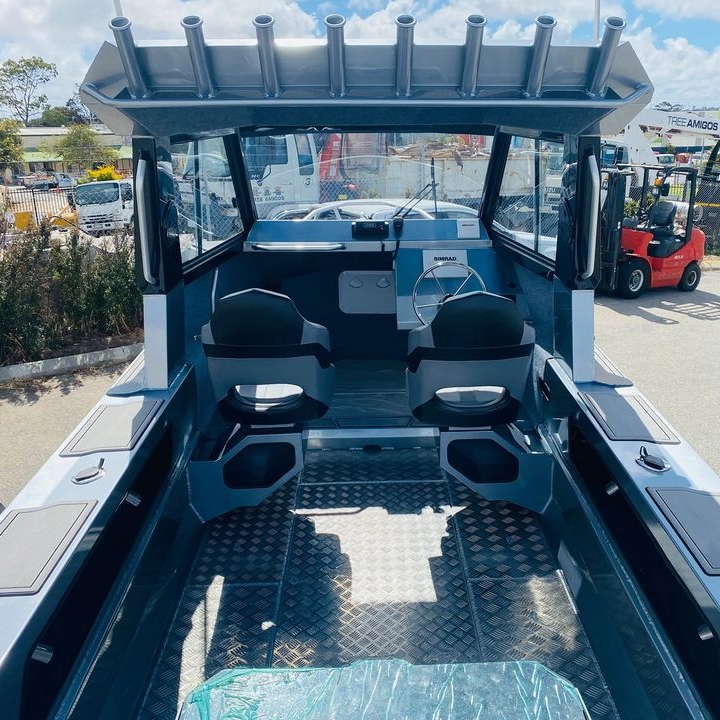
The marine industry developed a brilliant structural hybrid solution. We proudly introduce the Center Cabin configuration as a highly strategic alternative. It blends amazing 360-degree deck access with serious, hard-shell weather protection. You walk around the solid cabin structure seamlessly. A center cabin completely transforms a grueling morning commute. The crew sits comfortably behind heavy tempered glass windshields. They converse normally without constantly screaming over excessive wind noise. They sip hot coffee while monitoring the electronic radar screens in total comfort.
Let us closely examine the core evaluation criteria for this unique layout:
Pros: It offers highly secure, completely bone-dry storage. The fully enclosed helm provides exceptional shelter for tired crews. You gain realistic potential for overnighting trips. Lockable solid doors ensure absolute expensive gear security at transient marinas.
Cons: The physical cabin footprint inherently causes a slight reduction in side walkway width. The much taller solid roof structure creates increased aerodynamic windage. This noticeable windage can slightly alter your intended drift speeds during deep-water bottom fishing.
Shortlisting logic depends heavily on your specific geographic location. Cold weather fisheries practically demand enclosed helm stations. A heated cabin easily extends your active fishing season by several crucial months. Conversely, the open console excels entirely in tropical summer conditions. A sweltering cabin quickly becomes a miserable greenhouse in equatorial heat. Air conditioning requires a heavy onboard generator, complicating smaller vessel systems.
Average run times to distant fishing grounds also dictate this choice strongly. Hour-long runs in rough, excessively windy seas strongly favor solid cabin protection. Quick, ten-minute runs to local shallow reefs make open decks perfectly viable. Evaluate your most frequent offshore fishing routes honestly before choosing a layout.
Conclusion
Purchasing a fully dedicated ocean-going vessel remains a major lifestyle decision. Buying a center console represents a serious investment in pure, uncompromised fishability. It delivers unmatched utilitarian performance on highly turbulent open water. You quickly gain the mechanical physical advantages needed to land giant trophy fish consistently. Proper hull dynamics keep you incredibly safe when conditions deteriorate.
Alternatively, hybrid cabin designs intelligently solve critical weather exposure problems beautifully. They keep exhausted crews perfectly comfortable without sacrificing crucial deck access completely. Modern plate aluminum options provide extremely rugged, lightweight platforms for either layout style.
Before scheduling a formal on-water sea trial, take three actionable next steps:
Audit your local sea conditions and typical seasonal weather patterns strictly.
Calculate your specific vehicle towing capacity to finalize hull material choices accurately.
Define your primary fishing style, firmly choosing between active casting and stationary trolling.
Match your selected hull geometry directly to these personal metrics. You will definitely secure a reliable platform that enhances every single offshore adventure safely.
FAQ
Q: What is the minimum size for an offshore fishing boat?
A: Generally, 21 to 24 feet (approximately 6 to 7 meters) marks the absolute starting point for safe blue water capability. However, hull design matters significantly more than sheer overall length alone. A steep deadrise angle and appropriately high freeboard keep the vessel remarkably safe. A 20-foot boat engineered explicitly for heavy ocean swells easily outperforms a flat-bottom 24-foot bay boat offshore.
Q: How does a Center Cabin differ from a Walkaround?
A: A center cabin retains a deeply recessed walkway fully around the entire helm station. Anglers remain firmly on a single, continuous deck level while fighting fast fish. A traditional walkaround layout typically forces anglers to step up onto a raised bow area. This elevated step seriously compromises your physical footing during a chaotic fight in rough seas.
Q: Are aluminum center consoles safe for offshore use?
A: Yes, they are incredibly safe when engineered correctly by reputable builders. Manufacturers must use highly thick, marine-grade plate aluminum. The vessel requires a deep-V design tailored specifically for steep ocean swells, rather than a flat river profile. Additionally, builders must integrate sufficient positive flotation to meet very stringent international maritime safety standards.


