Venturing offshore is not just a matter of throttle and ambition. It is a calculated equation of fuel capacity, hull design, and the ever-changing sea state. Many beginners heavily underestimate the ocean's unpredictability. There is a massive difference between simply getting out to a distant reef and safely returning home when conditions deteriorate. Realistically, distance limits vary wildly across different vessel classes. You might only safely push 10 miles in a small, open center console. In contrast, specialized vessels can confidently conquer 100-mile trips into the deep blue.
Our goal here is clear. We provide a data-driven framework for evaluating exactly how far an offshore fishing boat can safely travel. You will learn the core structural requirements, fuel calculation rules, and critical safety realities. Ultimately, this guide helps buyers match their specific target fishing grounds with the correct vessel specifications to guarantee a secure return.
Key Takeaways
The 1/3 Fuel Rule: Safe offshore range is dictated by using 1/3 of fuel to reach the destination, 1/3 to return, and 1/3 held in reserve for weather/emergencies.
Size vs. Capability: While length matters, hull deadrise (deep-V), fuel tank size, and cabin protection (e.g., cuddy cabins) are the true metrics of offshore endurance.
Range Zones: Standard offshore trips range from 20–50 miles, while blue-water canyon runs often require platforms capable of 70–100+ mile round trips.
Vessel Selection: Choosing between a specialized aluminum model or a standard fiberglass hull dictates your maximum safe operating threshold in deteriorating weather.
Defining the Zones: How Far is "Offshore"?
Many buyers dramatically overestimate how far they need to travel. They often confuse what they want to catch with where those species actually live. We must define distances based on real-world fishing goals. This logical approach prevents you from under-equipping your vessel.
Near-Offshore (10–20 Miles)
You can easily reach local reefs and nearshore wrecks in this zone. You will primarily target coastal pelagics here. Smaller vessels handle this distance well on calm days. However, they remain highly sensitive to sudden weather shifts. A summer thunderstorm can turn a 15-mile run into a dangerous slog. You must maintain constant situational awareness.
Mid-Range Offshore (20–50 Miles)
This represents the standard deep-sea charter range. You cross out of sight of land. It requires reliable twin outboards. Alternatively, you can use a highly maintained single engine alongside auxiliary power. You must carry standard offshore communication gear. Sea conditions heavily dictate your cruising speed and crew comfort in this zone.
True Blue Water (50–100+ Miles)
You enter the Gulf Stream, deep canyons, or continental shelf drops here. This extreme distance demands commercial-grade hulls. You need massive fuel capacity. Advanced survival equipment is absolutely non-negotiable. You are entirely on your own in true blue water.
| Zone | Distance | Primary Targets | Vessel Requirement |
| Near-Offshore | 10–20 Miles | Snapper, Kingfish, Mackerel | 21ft+ entry-level hulls, fair weather only |
| Mid-Range | 20–50 Miles | Mahi-Mahi, Wahoo, Sailfish | 25ft+ deep-V hulls, reliable comms |
| True Blue Water | 50–100+ Miles | Marlin, Yellowfin Tuna, Swordfish | 28ft+ heavy-duty hulls, twin engines, survival gear |
Core Evaluation Criteria for an Offshore Fishing Boat
You must break down structural and mechanical factors objectively. These specific elements directly limit or extend your boat's range. Length alone does not equal capability.
Fuel Economics & Usable Range
You calculate maximum range using cruising RPM fuel burn rates. You must strictly follow the Coast Guard's recognized 1/3 fuel rule. You cannot use wide-open-throttle numbers. If your boat holds 150 gallons, only 50 gallons serve your outbound trip. You use another 50 gallons to return. The final 50 gallons stay in reserve. We always account for fighting heavy currents on the return leg. Weather changes quickly destroy your fuel efficiency.
Hull Design & Deadrise
A high degree of deadrise is mandatory. Deadrise measures the angle of the hull from the keel to the chine. A deep-V hull typically sits between 21 and 24 degrees. It cuts through offshore chop efficiently. It prevents hull integrity loss under stress. It also stops crew exhaustion. Pounding waves will quickly fatigue your passengers in a flatter hull.
Freeboard & Stability
High freeboard prevents dangerous swamping. Waves constantly strike the sides during stationary drifts. Generous gunwale height keeps ocean water out. It offers crew members physical security. You feel much safer leaning over high sides to gaff a fish.
Best Practice: Monitor your real-time fuel flow meters closely during the outbound leg to verify your actual MPG.
Common Mistake: Trusting manufacturer "light-ship" MPG specifications for heavy offshore route planning.
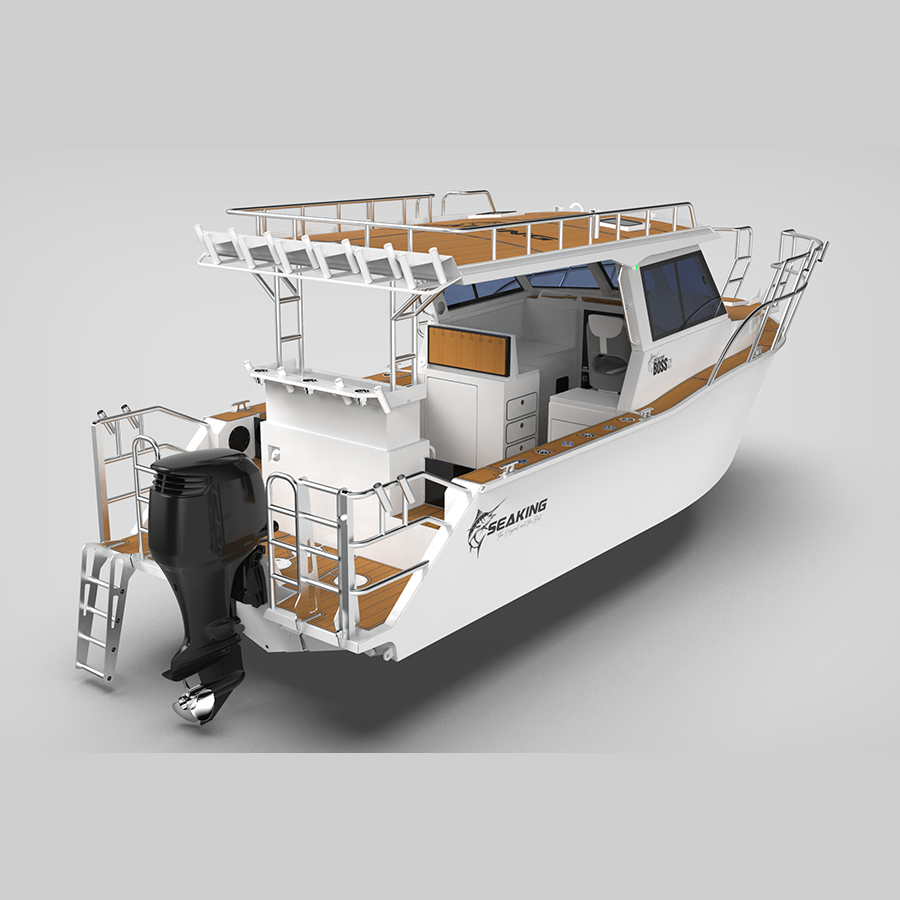
Evaluating Vessel Sizes and Layouts for Distance Operations
We map specific boat configurations to realistic offshore distances below. This logic aids your shortlisting process significantly. You can match the platform directly to your geographical needs.
Entry-Level Offshore (Under 25ft)
These boats remain strictly fair-weather dependent. They suffer from restricted fuel capacity. You cannot outrun fast-moving storm fronts easily. However, they serve a distinct purpose. The 25ft Cuddy Cabin Fishing Boat acts as a strategic entry point. It offers essential weather protection. You gain a dry resting area for 20–40 mile runs. It delivers this security without the heavy footprint of a massive cruiser.
Mid-Tier Performance (25ft – 28ft)
We consider this the operational sweet spot. It remains the most common size for serious weekend anglers. These hulls bridge the gap between trailerability and open-ocean safety. We look to models like the G2 Profisher750. We also highly evaluate the BOSS770MAX Offshore Fishing Boat. They exemplify optimized mid-range platforms. They balance towability perfectly. They provide the fuel capacity and deep-V stability needed for 50+ mile runs into rougher seas.
Heavy-Duty & Long-Range (Over 28ft / 8.5m+)
These larger vessels provide maximum ocean endurance. Builders design them for 80-100+ mile journeys. They often feature multi-day liveaboard capability. We position the 9m Easy Craft Fishing Boat as a benchmark for this top tier. Premium aluminum plate construction provides rugged durability here. It delivers a vastly increased fuel capacity-to-weight ratio. This engineering advantage proves critical for extreme blue-water distances.
The Hidden Risks: Implementation & Safety Realities
We must address real-world operational risks frankly. These specific factors dictate how far you can actually go. Manufacturer stated ranges mean very little in choppy seas.
Weight, Payload, and Fuel Burn
Added weight destroys vessel efficiency. You add four adult anglers. You load 300 lbs of ice. You fill massive livewells. Water weighs roughly 8.3 pounds per gallon. A 50-gallon livewell adds over 400 pounds instantly. This drastically reduces the theoretical range of an offshore hull. A boat getting 2.0 MPG light might drop to 1.3 MPG fully loaded. You must recalculate your 1/3 rule using the loaded MPG.
Mandatory Safety Redundancies
You need non-negotiable equipment before crossing the 20-mile mark. The ocean forgives very few mistakes.
Emergency Position Indicating Radio Beacons (EPIRBs) registered to your vessel.
Personal Locator Beacons (PLBs) attached to each crew member's life jacket.
VHF radios featuring Digital Selective Calling (DSC) for automated distress signals.
Satellite messengers for areas lacking standard radio reception.
Redundant automatic bilge pumps wired to completely separate batteries.
The "Single vs. Twin Engine" Debate
Heading 50 miles out on a single outboard carries inherent risks. Modern four-stroke outboards boast incredible reliability today. However, a submerged log can destroy a prop instantly. It can shatter a lower unit. Twin engines provide crucial security. They let you limp home on one motor. If you run a single engine offshore, you must carry a secondary kicker motor.
How to Shortlist Your Deep Sea Vessel
We provide a step-by-step decision framework for potential buyers. Follow this strictly to ensure safe operations.
Step 1: Define your primary target species. Map their average distance from your home port. Do not buy a 100-mile canyon-runner if you only fish coastal reefs 15 miles away.
Step 2: Calculate the required round-trip mileage. Apply the 1/3 fuel rule to find your absolute minimum fuel tank requirement. Always overestimate your burn rate. Assume you will fight a headwind on the way home.
Step 3: Choose the layout based on crew comfort and your local season. Opt for an enclosed cabin for cold-water protection. Choose an open center console for 360-degree tropical casting.
Next Steps: Advise yourself to audit sea-trial fuel burn data carefully. Review detailed performance bulletins for models like the BOSS770MAX or the 9m Easy Craft before finalizing any purchase. You want data showing fully loaded performance.
Conclusion
The distance a boat can go is a hard mathematical limit. It relies entirely on fuel capacity, hull class, and weather. It never relies on guesswork or optimism. Venturing offshore requires profound respect for ocean physics.
Always apply the 1/3 fuel rule based on fully loaded MPG data.
Match your hull design and deadrise to the specific wave conditions of your region.
Prioritize fuel capacity, hull thickness, and cabin protection over mere cosmetic features.
Never push past the 20-mile mark without redundant safety communication gear.
FAQ
Q: What is the minimum size boat needed for offshore fishing?
A: While skilled captains take 21ft boats offshore on calm days, 24-25ft is the baseline. A standard 25ft Cuddy Cabin Fishing Boat offers the length and bow height needed for handling sudden offshore weather changes safely.
Q: How do you calculate safe fuel range for an offshore trip?
A: You must emphasize the 1/3 rule. Use 1/3 of your fuel out, 1/3 back, and keep 1/3 in reserve. Always base this math on the boat's loaded cruising MPG, never its top speed MPG.
Q: Is an aluminum boat or fiberglass boat better for going far offshore?
A: Both have distinct merits. Fiberglass offers a heavier, softer ride in choppy conditions. Premium plate aluminum boats, like the 9m Easy Craft Fishing Boat, offer superior durability, lighter towing weights, and excellent range-to-weight ratios.
Q: Can you take a single-engine boat 50 miles offshore?
A: Yes, given modern four-stroke reliability. However, it strictly requires auxiliary safety gear like an EPIRB and a satellite phone. You should ideally carry a kicker motor. Twin engines remain the industry standard for 50+ mile runs.


