Serious ocean fishing is very different from casual boating near the shoreline. Once anglers travel farther offshore, conditions become more demanding and expectations for the vessel increase dramatically. Strong waves, longer travel distances, and unpredictable weather require a boat that can deliver stability, safety, and endurance. That is why choosing the right Offshore Fishing Boat becomes one of the most important decisions for anglers planning serious trips. These vessels are specifically designed to handle open water environments while providing the performance, comfort, and reliability needed for extended fishing journeys. Understanding what makes an offshore fishing boat truly effective helps buyers recognize the value of a purpose-built design rather than relying on boats intended only for calm waters.
What is the biggest difference between offshore and ordinary fishing boats?
Offshore conditions are less forgiving
Fishing close to shore often means calmer water and shorter travel distances. Offshore fishing, however, exposes the boat to stronger waves, deeper water, and changing weather conditions. These factors demand a vessel capable of maintaining stability even when sea conditions shift quickly.
Offshore boats are engineered with stronger hull structures and improved hydrodynamic performance to ensure they remain dependable during long journeys away from land.
The boat must support longer, more demanding runs
Offshore fishing trips usually involve longer travel distances to reach productive fishing grounds. Boats must therefore maintain consistent speed and efficiency while carrying passengers, equipment, and fuel for extended outings.
A well-designed offshore vessel ensures that anglers can travel farther without sacrificing comfort or safety.
Why design margins matter much more offshore
Engineering margins are critical for offshore vessels. Stronger materials, reinforced structures, and carefully balanced hull geometry help the boat maintain performance when conditions become challenging.
These design considerations allow the vessel to handle repeated exposure to waves, wind, and heavy loads without compromising safety.
How does an offshore fishing boat improve safety and confidence?
Hull designs built for rougher water
Hull design plays a major role in offshore safety. Deep-V hulls are widely used in offshore fishing boats because they cut through waves more effectively than flatter designs. This shape reduces impact from waves and improves directional stability.
A well-designed hull allows the boat to travel through rough water with greater confidence, making long-distance fishing trips safer and more comfortable.
More stable movement in changing sea conditions
Stability is essential when fishing offshore. Anglers often move around the deck while managing fishing lines and equipment, so the boat must remain balanced even when waves shift beneath it.
Offshore fishing boats typically feature wider beams and optimized weight distribution to maintain steady movement and reduce excessive rolling.
Cabin or protected space as a real comfort advantage
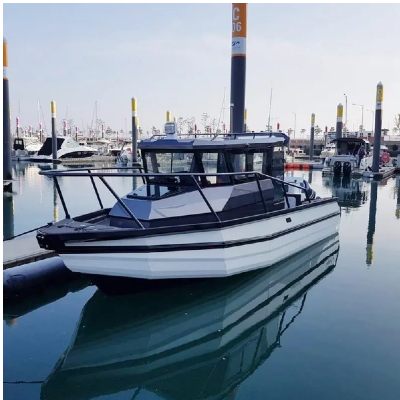
While open deck space is important for fishing activity, offshore trips also benefit from having protected cabin areas. These spaces offer shelter from wind, rain, and intense sunlight, allowing passengers to rest during long journeys.
A small cabin can also serve as storage for essential equipment and personal items, helping keep the deck organized and functional.
Why is structural strength so important offshore?
Repeated impact from waves and open-water use
Offshore boats experience constant wave impact, especially during longer journeys. Each wave generates pressure against the hull structure, which requires strong materials and precise construction.
Without sufficient structural integrity, a boat may struggle to maintain long-term durability in demanding marine environments.
Material quality and long-term durability
Material selection is one of the most important factors in boat construction. High-quality marine materials ensure that the vessel remains reliable even after years of use in challenging conditions.
Strong construction methods and professional welding techniques contribute to the long-term strength of the boat.
Why marine-grade aluminum is a strong value case
Marine-grade aluminum has become increasingly popular in offshore fishing boat construction. This material offers excellent durability while remaining lighter than many traditional alternatives.
Aluminum structures resist corrosion and maintain structural strength even in saltwater environments, making them well suited for offshore fishing operations.
What practical fishing advantages do buyers gain?
Better access to deeper and less crowded waters
One of the greatest benefits of offshore fishing is the ability to reach areas that are less crowded and often more productive. Offshore fishing boats allow anglers to travel farther from shore, where larger fish species are frequently found.
Access to these deeper waters expands fishing opportunities and increases the potential for memorable catches.
More room for gear, tackle, and catch management
Offshore fishing typically requires more equipment than casual coastal fishing. Rods, tackle boxes, bait systems, and storage compartments all need space on board.
A properly designed offshore boat provides organized storage areas and open deck space so anglers can manage their gear efficiently.
Better trip endurance for longer outings
Long offshore trips demand boats that can carry sufficient fuel, supplies, and equipment. Larger fuel capacity and efficient hull design allow anglers to remain on the water for extended periods without constant concern about range.
This endurance allows fishing trips to focus on results rather than logistical limitations.
Why do comfort features matter more than many buyers expect?
Reduced fatigue on longer runs
Traveling offshore often involves long distances before reaching fishing grounds. Comfortable seating, stable ride quality, and shelter from wind help reduce fatigue for passengers.
Less fatigue means anglers can remain focused and energized during the fishing portion of the trip.
More usable shelter from weather
Weather conditions can change quickly in offshore environments. Having a cabin or protected space allows passengers to stay comfortable when wind or rain appears unexpectedly.
This protection makes offshore trips more enjoyable and encourages longer adventures.
A better experience for mixed crew, not just hardcore anglers
Not every passenger on a fishing trip is an experienced angler. Families and friends often join these outings for the experience rather than the catch itself.
Comfortable seating, sheltered areas, and organized deck layouts make offshore trips more enjoyable for everyone on board.
How do performance and efficiency support a better offshore trip?
Better wave handling can improve travel confidence
Performance in waves determines how comfortable the journey will be. A well-designed hull reduces pounding and improves control, allowing the vessel to travel through waves smoothly.
This improved performance helps anglers reach distant fishing grounds with greater confidence.
Balanced hull design can support smoother running
Hull balance influences how the boat sits in the water and how it responds to wave movement. Proper weight distribution allows the vessel to maintain steady motion and reduces excessive rolling.
Smooth running improves both comfort and safety during offshore travel.
Correct engine pairing matters for usable performance
Engine selection must match the boat’s size and intended purpose. Adequate horsepower allows the vessel to maintain efficient cruising speeds and respond quickly when conditions require adjustments.
Reliable engines also ensure that the boat can travel long distances safely.
Offshore fishing boat benefits overview
Offshore feature | Why it matters on real trips |
Stronger hull design | Greater confidence in rough water |
Protected cabin space | Comfort during long journeys |
Marine-grade aluminum | Durability and corrosion resistance |
Stable running attitude | Improved control and reduced fatigue |
Practical deck layout | Efficient fishing workflow |
Why is a multi-purpose offshore boat more appealing to today’s buyers?
Fishing performance plus leisure usability
Many modern boat buyers prefer vessels that can serve multiple purposes. Offshore fishing boats designed with practical cabins and comfortable seating allow owners to enjoy both fishing trips and recreational outings.
This versatility increases the value of the boat and expands the types of activities it can support.
Better return on ownership
A multi-purpose vessel allows owners to use the boat more frequently. Instead of limiting its use to specific fishing trips, the boat can also support family outings, sightseeing trips, or relaxing cruises along the coastline.
More frequent use often leads to better overall value from the investment.
Why buyers increasingly want one boat that does more
Modern boating lifestyles often involve mixed activities. Owners may fish one weekend and take family members on leisure cruises the next.
Offshore fishing boats with thoughtful design and comfortable layouts support these diverse needs while maintaining the performance required for serious fishing trips.
Conclusion
The best open sea fishing boat is not simply defined by its size or engine power but by how well it performs in real offshore environments. Stability, durability, comfort, and reliable performance all contribute to a vessel capable of handling serious fishing trips. Qingdao Gospel Boat Co., Ltd., located in the coastal city of Qingdao, China, specializes in designing and manufacturing high-quality aluminum boats for customers around the world. The company produces a wide range of vessels including fishing boats, landing craft, patrol boats, pontoon boats, passenger boats, and catamarans, all built to help more people enjoy safe and comfortable experiences on the water.
Contact us today to learn more about aluminum offshore fishing boats and discover practical solutions designed for demanding marine adventures.
FAQ
What makes an offshore fishing boat different from other boats?
Offshore fishing boats are designed to handle stronger waves, longer travel distances, and heavier loads. They feature stronger hull construction, powerful engines, and layouts optimized for fishing activities.
Why is hull design important for offshore fishing boats?
Hull design determines how a boat performs in waves. Deep-V hulls improve wave-cutting ability, stability, and ride comfort, making them ideal for offshore conditions.
Are aluminum offshore fishing boats reliable?
Yes. Marine-grade aluminum provides strong structural durability and corrosion resistance, making it suitable for demanding offshore environments.
What features should anglers look for in an offshore fishing boat?
Important features include a strong hull structure, stable deck layout, reliable engine power, storage space for fishing equipment, and protective cabin areas for comfort during long trips.


