Selecting the right floorplan acts as the most critical choice in your final purchasing or custom-build decision. It establishes the baseline for your entire on-water experience. A pontoon boat layout dictates far more than simple passenger comfort. It actively controls structural balance, defines legal weight capacity, and dictates activity-specific functionality. You will find it structurally complex and highly inefficient to modify these foundational elements after manufacturing. Buyers must carefully align their chosen chassis size and deck configuration directly to their primary operational goals. Designing a vessel for private weekend recreation requires entirely different math than setting up a commercial touring operation. We will explore how engineering realities shape your floorplan choices. You will learn to match specific deck configurations to your core activities, scale chassis specifications properly, and evaluate hidden implementation risks before finalizing your design.
Key Takeaways
Floorplan configurations must be prioritized over cosmetic features, as retrofitting deck layouts is structurally complex and cost-prohibitive.
The choice between a 5.8m, 6.4m, and 7m chassis directly limits layout options based on weight distribution and buoyancy physics.
Commercial tour and high-capacity party setups require specific compliance evaluation, particularly when considering multi-level or double-deck structures.
True multi-purpose layouts require calculated trade-offs between open deck space (for fishing) and fixed seating (for entertaining).
The Engineering Reality of a Pontoon Boat Layout
Many buyers focus heavily on aesthetic preferences during the initial design phase. We urge you to move past upholstery colors and vinyl patterns. You must understand deck plans as a strict exercise in weight distribution and spatial efficiency. Framing this as a foundational engineering problem prevents dangerous modifications later. When you treat the floorplan as a mathematical equation, you make safer structural choices.
Every piece of furniture impacts the vessel's trim and handling in the water. Center of gravity determines how safely your boat maneuvers. Heavy items like centralized consoles, marine batteries, and large aerated livewells shift the balance drastically. If you place too much weight near the bow, the front tubes will plow into the waves. This plowing effect reduces steering control and increases water splashing over the deck. Placing too much weight near the stern causes propeller ventilation. You must balance load distribution evenly across the aluminum cross-members to ensure stable buoyancy.
Buyers frequently underestimate the permanence of fixed structural footprints. Standard modular layouts seem flexible on paper. In reality, structural hardpoints dictate exactly where heavy features must lock into the chassis. Rails, helms, and heavy entertainment bars bolt directly into specific reinforced cross-members below the deck. You cannot simply slide a steering console three feet backward. The helm requires rigid structural support for steering cables, throttle wiring, and electrical harnesses. Recognizing these fixed limitations helps you choose a layout you can live with long-term.
Purpose-Built Configurations by Core Activity
Dedicated Fishing Layouts
Anglers require highly specific deck configurations. The popular 4-point configuration places four pedestal seats in the extreme corners of the deck. This setup provides a 360-degree casting arc. You can fish off the bow, stern, port, or starboard sides without structural interference. Removing bulky perimeter couches creates a clear walking path for landing large fish.
When evaluating a fishing floorplan, you must prioritize mechanical clearances. Ensure sufficient rod clearance around the bimini top hardware. Trolling motors require dedicated bow clearance. They need a reinforced half-gate to deploy safely without hitting the aluminum fencing. You must also evaluate integrated aerated livewell positioning. Livewells hold heavy water volumes. Placing them too close to one side causes an uneven list. The major trade-off remains obvious: maximizing open deck space significantly reduces overall passenger seating.
Party and Entertainment Setups
Socializing architecture focuses on group interaction. A strong entertainment layout utilizes L-group or U-shaped aft seating to create a central conversation pit. These designs face passengers inward. Many modern entertainment setups incorporate centralized bar consoles. These consoles provide built-in cup holders, prep stations, and secure storage for coolers.
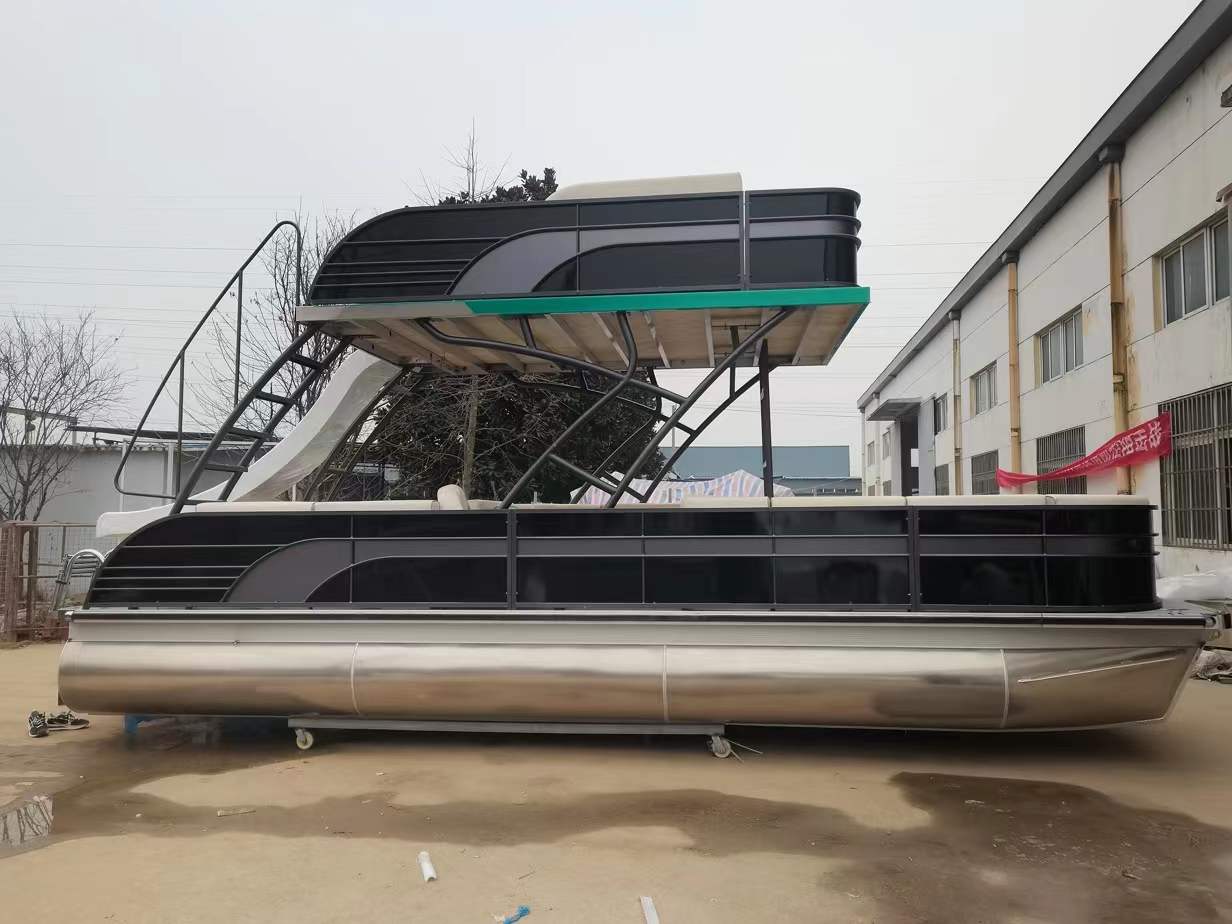
High-capacity socializing often leads buyers to consider a double-deck pontoon boat. Upper decks provide fantastic lounging areas. Many include integrated water slides for family entertainment. However, you must evaluate the structural necessity of these features against the physical drawbacks. Adding a second level drastically increases windage. The tall profile catches crosswinds easily. This makes docking difficult. The higher center of gravity also introduces noticeable body-roll during sharp turns.
Commercial Tour & Passenger Layouts
Commercial operators face strict compliance-driven design requirements. Maximum headcount drives revenue. Therefore, commercial layouts utilize continuous perimeter bench seating. This layout pushes all passengers against the outer rails. It maximizes legal seating capacity while leaving the deck center completely open.
Safety regulations demand wide, unobstructed center aisle clearances for rapid ingress and egress. Operators must also guarantee wheelchair accessibility through extra-wide side gates. Commercial layouts prioritize durable, low-maintenance materials over plush aesthetics. Furthermore, rigid perimeter seating restricts random weight shifting during transit. Keeping passengers seated securely prevents sudden listing when running through rough harbor chop.
Scaling the Floorplan: 5.8m to 7m Specifications
The 5.8m Pontoon Boat (Agility & Specialization)
A 5.8m pontoon boat excels in maneuverability. Success criteria for this size focus on agility. This footprint proves ideal for calm inland lakes and rivers. Its shorter length makes navigating tight docking slips incredibly easy. Many buyers use this size for specialized purposes like pure fishing or small-family evening cruising.
However, this size carries distinct limitations. A smaller chassis possesses less overall buoyancy. It cannot safely support heavy entertainment consoles. Trying to squeeze large group capacities onto this deck compromises the draft. Pushing the tubes too deep into the water drastically reduces top-end speed and fuel efficiency.
The 6.4m Pontoon Boat (The Hybrid Sweet Spot)
The 6.4m pontoon boat serves as the marine industry standard. It achieves excellent success balancing competing needs. This size provides enough deck length to support a fishing aft while maintaining a plush lounging bow. Families love this hybrid approach.
Implementation realities make this size incredibly versatile. It comfortably supports 8 to 10 passengers without feeling cramped. The extra length allows designers to separate distinct activity zones. Kids can jump off the front swim platform while adults relax in the rear conversation pit. The weight distribution naturally balances dual-purpose furniture.
The 7m Pontoon Boat (High Capacity & Commercial Foundations)
Buyers looking for maximum space turn to the 7m pontoon boat. Success criteria here center on large-scale entertaining and robust stability. This footprint handles commercial tour groups exceeding 12 passengers easily. The longer tubes span across rougher coastal chop, providing a remarkably smooth ride.
When evaluating structural dimensions, this represents the absolute baseline size required for heavy superstructures. If you want a dual-level layout, you need this foundation. A shorter vessel cannot safely stabilize the towering weight of an upper deck.
Chassis Size and Layout Capabilities Comparison
| Chassis Size | Ideal Primary Use | Optimal Passenger Capacity | Heavy Console / Second Deck Support |
| 5.8 Meters | Dedicated Fishing, Small Lakes | 4 to 6 Passengers | Not Recommended |
| 6.4 Meters | Hybrid Family Cruising & Watersports | 8 to 10 Passengers | Marginal (Requires Tritoon Upgrade) |
| 7.0+ Meters | Commercial Tours, Large Parties | 12+ Passengers | Highly Supported |
Evaluating Structural Trade-offs & Implementation Risks
Many first-time buyers fall into the "Do-It-All" trap. They attempt to cram fishing pedestals, massive party couches, and a changing room into a single floorplan. This approach results in a cluttered, unnavigable deck. You bump into furniture constantly. Finding a balance means accepting some limitations. A highly specialized deck performs one task perfectly. A generalized deck performs several tasks adequately but masters none.
Weight rating compliance requires strict attention. Manufacturers engineer specific layouts to match the exact buoyancy of the underlying tubes. Adding heavy aftermarket furniture later invalidates manufacturer warranties. Modifying a pontoon boat blindly compromises passenger safety. An under-sized chassis will sit too low in the water if overloaded. You risk swamping the deck during rough weather.
You must also calculate windage and draft factors carefully. Tall layouts act as massive sails in high winds. Large bimini tops, solid upper decks, and enclosed changing rooms catch strong crosswinds. Piloting a tall vessel in a crowded marina requires significant skill. Furthermore, heavier layouts push the tubes deeper into the water. Increased draft means you might scrape the bottom in shallow coves. You will likely require larger outboard engines to overcome the added water resistance and maintain cruising speeds.
Shortlisting Your Ideal Layout: A Decision Framework
Choosing the perfect configuration does not have to feel overwhelming. Use this proven three-step decision framework to lock in your specifications.
Define the Primary 80% Use Case: You must force a hard decision here. Determine what you will do 80% of the time on the water. Will you primarily fish, cruise, or operate a commercial tour? Let this primary use case dictate your baseline seating architecture.
Match Capacity to Chassis Size: Align your expected regular passenger count with the correct physical footprint. Choose the 5.8m, 6.4m, or 7m hull based on strict weight capacities, not just budget.
Evaluate Tube Configuration: Carefully analyze your foundational support. Standard two-tube setups work fine for basic cruising. Heavy layouts featuring wet bars or double decks require tritoon (three-tube) foundations. A third center tube provides the necessary displacement to float heavy structures safely.
As an actionable next step, we strongly recommend consulting directly with manufacturers for standardized floorplan schematics. Review proven engineering blueprints before attempting any custom deck designs.
Conclusion
Securing the highest functional return on your marine investment begins with a pragmatic assessment of space. You must respect the mathematical limits of weight distribution and tube buoyancy. A visually stunning vessel fails if it lacks the structural balance to navigate safely.
Buyers should lock in their primary layout and chassis size first. Treat outboard engines, stereo systems, and cosmetic upgrades as secondary variables. Follow the engineering guidelines closely. Match your primary activities to purpose-built seating configurations. By respecting windage, center of gravity, and legal capacities, you ensure decades of safe, enjoyable operation on the water.
FAQ
Q: Can I change the layout of my pontoon boat later?
A: Modifying a floorplan later is highly difficult and expensive. Moving helms requires rewiring electrical harnesses and rerouting steering cables. Shifting heavy furniture alters the engineered weight balance, potentially causing dangerous listing. Always get the primary layout right at the initial purchase.
Q: What is the best pontoon boat layout for both fishing and family cruising?
A: The "Fish & Cruise" hybrid serves this dual purpose perfectly. This layout features rear casting decks with pedestal seats for anglers. It pairs these rear stations with forward L-bench seating and lounge couches, giving families plenty of comfortable space up front.
Q: Is a double-deck pontoon boat safe for high passenger capacities?
A: Yes, provided the vessel uses a heavily reinforced foundation. The upper deck carries strict weight limits to prevent rollover risks. Safe high-capacity operations require at least a 7m tritoon (three-tube) foundation to stabilize the elevated center of gravity against strong winds.
Q: How does a 6.4m pontoon boat compare to a 5.8m for commercial tours?
A: The longer 6.4m chassis mathematically increases legal passenger capacity and provides required center aisle space. The 5.8m lacks the buoyancy and deck length to support crowded perimeter seating safely. Commercial buyers should always push toward larger models to maximize compliant headcount.


